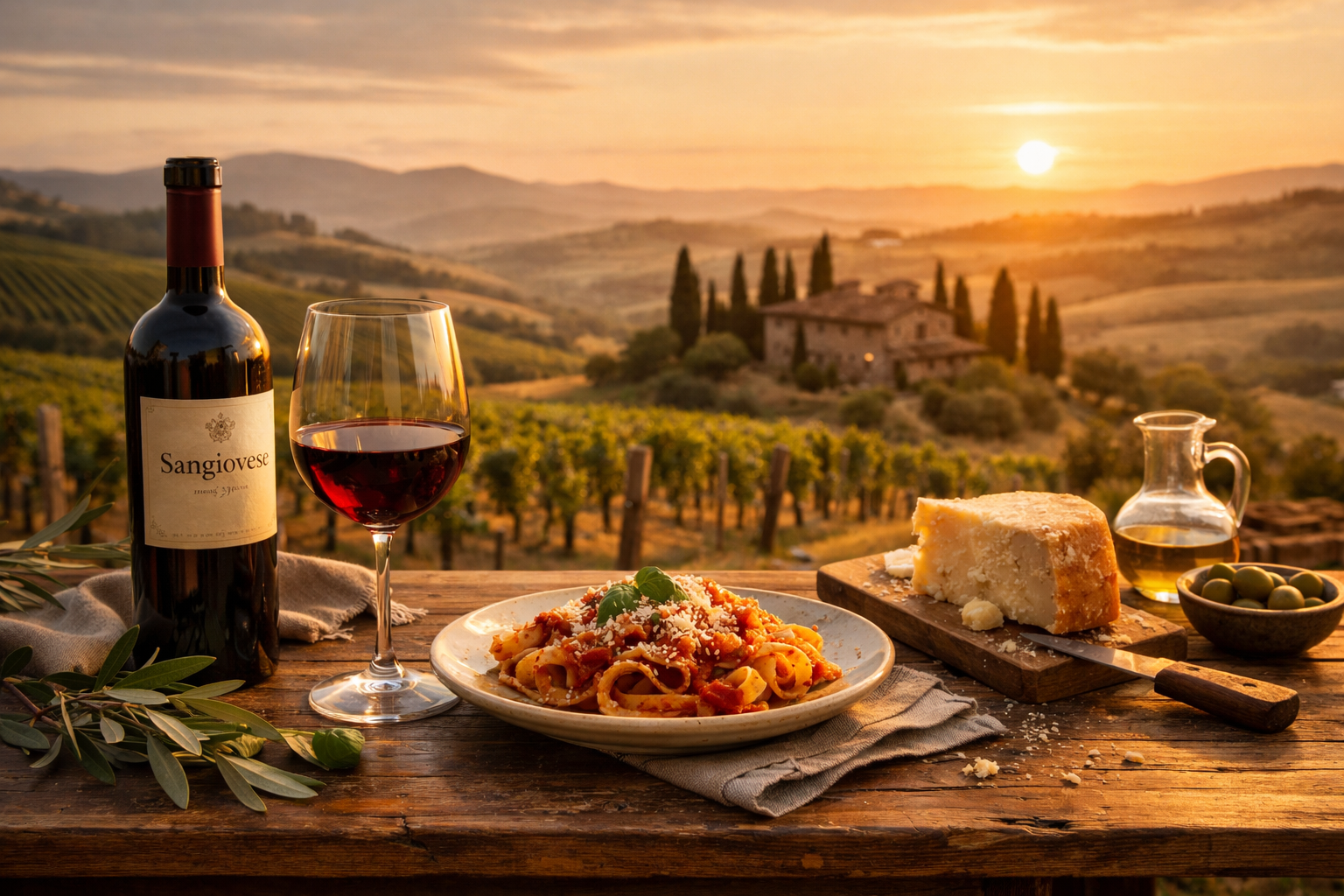
Sangiovese: a journey through Chianti, Montalcino, Montepulciano & the irresistible pull of Tuscany.
If a place could taste like sunshine on terracotta rooftops, olive oil still warm from the press, and a linen tablecloth fluttering in a vineyard breeze — it would taste like Sangiovese.
This grape isn’t just a variety.
It’s a mood.
It’s a road trip.
It’s the reason you suddenly start craving tomato sauce and booking flights at 1:17am.
Sangiovese is Italy’s most important red grape, yet for many wine drinkers it hides behind region names rather than appearing boldly on a label. You won’t always see the word Sangiovese — but if you’ve loved Chianti, Brunello di Montalcino, Vino Nobile di Montepulciano, or Morellino di Scansano… you’ve already fallen for it.
And that is exactly what makes Sangiovese endlessly fascinating.
What Does Sangiovese Taste Like?
Sangiovese is not a heavy wine.
It’s not a soft wine.
It’s not a shy wine either.
It lives in tension — and that’s its magic.
Typical Sangiovese tasting notes:
- Tart cherry
- Red plum
- Sun-dried tomato
- Dried oregano
- Fresh herbs
- Leather
- Tobacco
- Earth
- Crushed stone
The first sip usually surprises people. Instead of sweetness or plushness, you get bright acidity and structured tannins — the kind that gently grip your cheeks and instantly make you hungry.
This is why Sangiovese is one of the world’s greatest food wines.
It doesn’t sit beside dinner… it activates dinner.
Pizza tastes more tomato-y.
Pasta tastes richer.
Parmigiano suddenly tastes like a luxury item.
The wine was never meant to be sipped alone. It was meant to live at a table.
Why Sangiovese Tastes Different Everywhere
Here’s the secret: Sangiovese is extremely sensitive to place (what wine people call terroir).
Move it 40 kilometers and the personality changes.
Same grape. Different experience.
That’s why instead of learning one wine — you can explore an entire map of Tuscany.
Chianti — The Gateway to Sangiovese
Chianti is where most people first meet Sangiovese.
Rolling hills, cypress trees, stone farmhouses — this is postcard Tuscany, and Chianti is its everyday wine.
Modern Chianti (especially Chianti Classico) is primarily Sangiovese and delivers:
- bright cherry fruit
- floral violet aromas
- medium body
- lively acidity
This is your weeknight pasta wine, your pizza night wine, your “friends stayed longer than expected” wine.
Chianti teaches you what Sangiovese is.
Then the regions nearby teach you what Sangiovese can become.
Brunello di Montalcino — The Noble Expression
Drive south to the hilltop town of Montalcino and everything changes.
Here, Sangiovese (locally called Brunello) ripens more slowly and more completely. The wines must age longer before release, and the result is profound.
Brunello di Montalcino is deeper, darker, and more layered:
- black cherry
- fig
- dried roses
- cedar
- spice
- leather
The tannins are firmer, the finish longer, and the wine evolves beautifully in the glass for hours.
This is the bottle you open when the meal matters.
It doesn’t accompany the evening — it becomes the memory.
Vino Nobile di Montepulciano — The Elegant Middle Ground
Confusingly, Montepulciano (the town) is not made from the Montepulciano grape.
Here again — it’s Sangiovese.
Called Prugnolo Gentile locally, it produces Vino Nobile di Montepulciano, one of the most balanced and underrated wines in Italy.
Think of it as the bridge between Chianti and Brunello:
- softer than Brunello
- richer than Chianti
- refined but still approachable
It’s the wine I often recommend to people who say, “I want something impressive but not intimidating.”
Morellino di Scansano — The Hidden Gem
Travel west toward the Tuscan coast and Sangiovese becomes sun-kissed.
Morellino di Scansano is brighter, juicier, and more relaxed:
- ripe cherry
- strawberry
- Mediterranean herbs
- softer tannins
It feels like seaside Tuscany — olive groves, warm evenings, grilled meats, and no rush whatsoever.
If Chianti is countryside and Brunello is ceremony, Morellino is vacation.
Why You Should Try All of Them
Sangiovese isn’t one wine. It’s an experience of geography.
By tasting across these regions, you’re not just learning wine — you’re learning how soil, sun, elevation, and tradition shape flavor. Few grapes in the world demonstrate terroir as clearly.
But don’t stop at trying different regions — try different ages, too.
Sangiovese is one of the most expressive grapes when it comes to time in bottle. A younger Chianti or Rosso di Montalcino will feel vibrant and energetic — bright cherry, fresh herbs, lively acidity, and tannins that still have a little grip. It’s all about freshness and food.
Now open a bottle with 8, 10, or even 15 years of age, and the transformation is remarkable. The fruit deepens into dried cherry and fig, the tannins soften into silk, and savory notes of leather, tobacco, and spice begin to unfold. The wine feels less about brightness and more about depth.
Tasting a young Sangiovese beside an aged one is like seeing Tuscany at noon and again at sunset. Same landscape. Different light. Entirely new experience.
Food Pairing: Where Sangiovese Truly Comes Alive
Sangiovese has naturally high acidity — the same acidity found in tomatoes.
That’s why it pairs almost perfectly with Italian cuisine.
Best pairings:
- Margherita pizza
- Lasagna
- Bolognese
- Mushroom risotto
- Eggplant parmigiana
- Aged pecorino
- Prosciutto
- Grilled steak
It cuts richness, highlights herbs, and cleanses the palate after each bite. One sip resets the fork.
Want to Explore Sangiovese With Guidance?
Affiliate Disclosure:
This article contains affiliate links. If you choose to enroll in a wine education program through the links below, I may earn a small commission—at no additional cost to you. I only recommend wine resources I genuinely trust and believe add value to your wine journey.
The easiest way to truly understand these wines is tasting them side-by-side with context — learning what to look for, what to smell, and why they differ.
If these wines spark your curiosity and you’d like to deepen your understanding—whether for personal passion or professional growth—I highly recommend exploring formal wine education.
You can learn more through trusted programs like:
- Wine Scholar Guild – in-depth regional studies for true wine lovers
- WSET (Wine & Spirit Education Trust) – globally recognized wine certifications
I’ve included affiliate links below for anyone interested in exploring these programs further. They’re an excellent way to refine your palate, deepen your knowledge, and truly understand what’s in your glass.
Because the real goal of wine isn’t collecting bottles.
It’s creating moments.
Exclusive WSET Savings with Fine Vintage
Fine Vintage offers 10% savings on in-person or online WSET courses when you enroll using the special code TanninsandTravel —an ideal next step for both enthusiasts and professionals.
Enjoy 10% off Wine Scholar Guild programs
If this exploration of Italian wine has inspired you to learn more, Wine Scholar Guild is offering 10% off select courses through this link —an excellent opportunity to deepen your wine knowledge with one of the industry’s most respected educators.
Final Pour – The Tannins and Travel Takeaway
Sangiovese doesn’t shout like Cabernet or seduce like Pinot Noir.
Instead, it invites you. It asks you to slow down, pour another glass, and stay a little longer at the table.
And eventually, you realize the secret:
You didn’t just find a wine. You found a place you want to return to.